


How can one man’s historic actions reverberate through our built environment? The Marquis de Lafayette was a storied ally of American revolutionaries, the glue that bound two cultures together. This intercultural diffusion is plainly exhibited in the eponymous city of Lafayette, IN. Founded in 1825, the city was as beholden to traditional European architectural styles as any other city of the day. This influence is visible in its many Neoclassical, Queen Anne, Tudor, and Italianate buildings. Yet, the most poignant of European influences comes from the same country as Lafayette himself, France. Two schools endemic to France, Beaux Arts and Second Empire, dominate Lafayette’s downtown and historic neighborhoods. One building in particular serves as an exemplar of these styles, the Tippecanoe County Courthouse.
Beaux-Arts, meaning “fine arts,” grew out of the educational traditions of the École des Beaux-Arts in Paris. A prestigious institution founded in 1648. The style came from the mid-19th century and was popularized after the French Revolution. It was commonly used for public buildings like libraries and museums. Some of its features include: Polychromy (use of multiple colors), sculptures, grand facades, and other ornamental details.
Second Empire was a style popularized under the rule of Napoleon III during the Second French Empire. The style was never formally codified, rather an assembly of certain aesthetic qualities from the time period. Its defining features are: Mansard Roofs, Dormer Windows, luxurious building materials, and polychromy. The Second Empire style was commonly used for hotels, palaces, and mansions, befitting its imperial lineage.

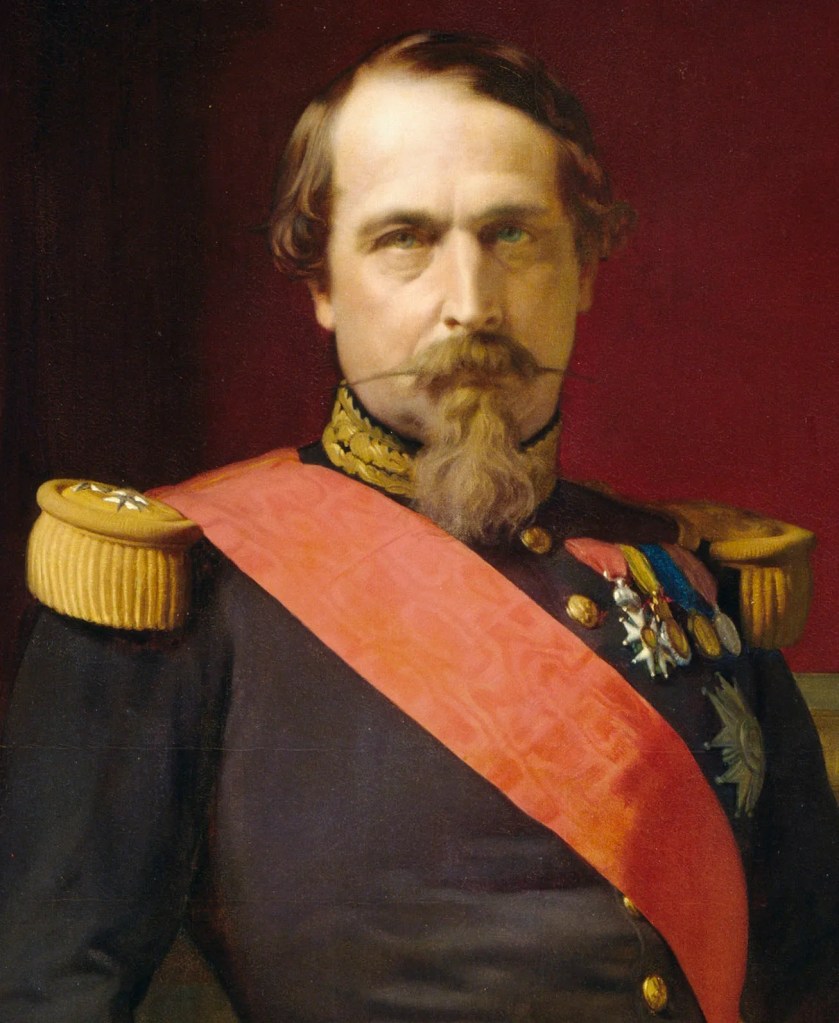
The Tippecanoe County Courthouse is actually Tippecanoe’s third county courthouse. The first court and second court were Colonial and Neo-Classical respectively. Both were demolished over time leading to the third and final court being built in 1882. The original price was $208,000, yet due to the scale and opulence of the project an extra $241,000 was granted. The courthouse was completed in 1884 at a cost of $500,000 which is an eye-watering $16,200,000 dollars today. It was designed by local architect Elias Max, and it has 8 courts in total.
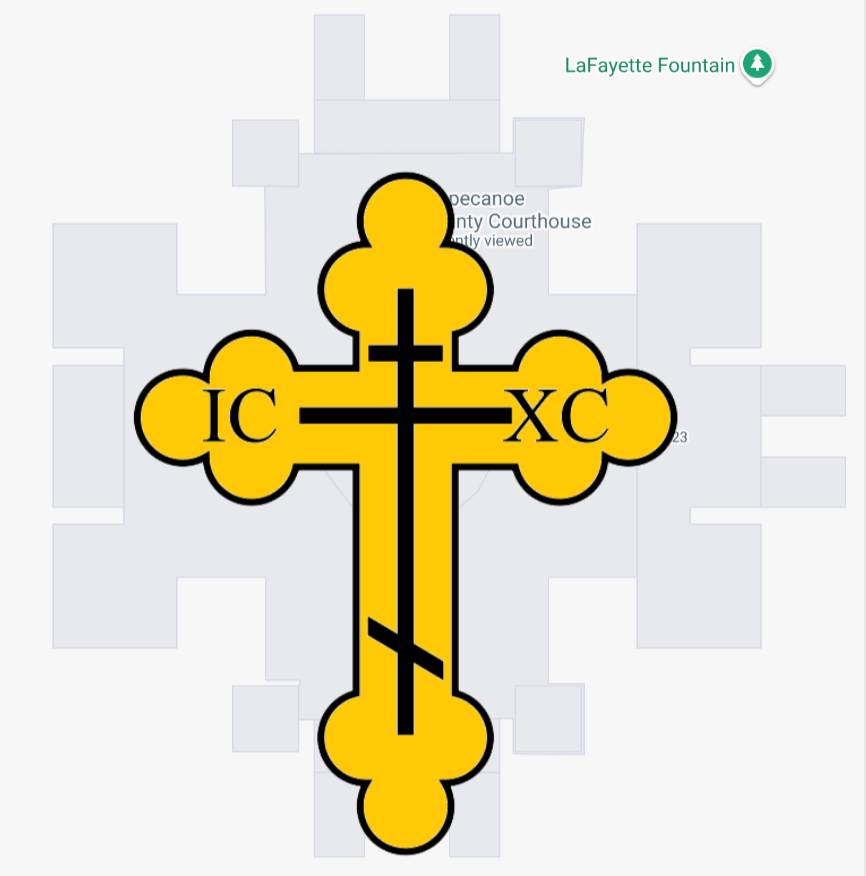
The Courthouse is an architectural amalgam of multiple different styles. Beaux-Arts, Second Empire, and Neoclassical being the principal ones. It also has very pronounced massing styled in the manner of a Greek Cross. It features a mixture of convex and straight Mansard roofing with four clock faces and an elongated dome. It was constructed using Indiana limestone and has over 100 columns. It features 9 statues, and is crowned by a 14 foot statue depicting Liberty.
This building is beautiful and the centerpiece of Lafayette, but it is flawed. In my opinion the building is overly eclectic with its multiple styles and motifs undermining its visual consistency. The first thing that comes to mind are the multiple ornaments on top of the building. The combination of Mansard roofing, clock faces, 9 statues, 100 columns, and an elongated dome serve to draw eyes upward. Additionally, the engraved pediments and High-Victorian Gothic windows make the building seem like a checklist of expensive architectural motifs. The building is overly top-heavy, with the bottom half of it not coming close in regards to visual grandeur. Even taking some of these factors in isolation serves to illustrate visual inconsistency. The Mansards for example are both convex and straight, instead of being a streamlined style. All of this opulence and experimentation came at a cost, almost double its original budget. American author Mark Twain said upon his visit to Lafayette, “you have a very striking new courthouse; very striking indeed. I should judge that the courthouse struck the taxpayers a very hard blow!” I feel that this statement perfectly summarizes my critiques. The courthouse is opulent, but it brings to mind egregious government waste instead of civic pride.
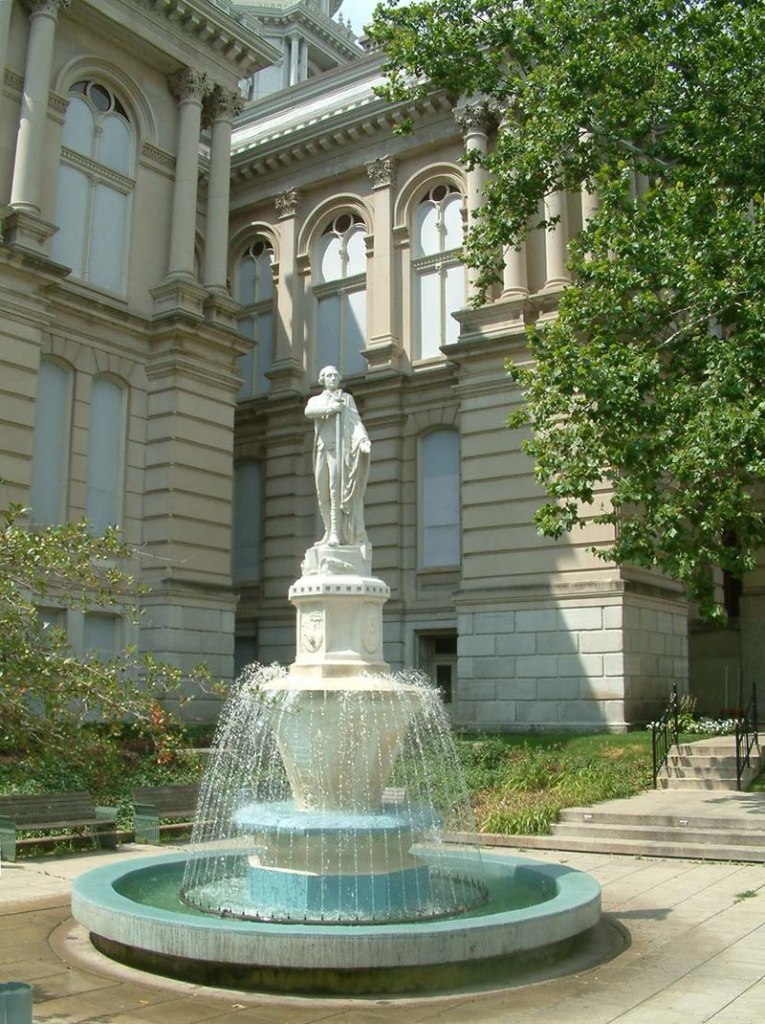
Yet, despite all of my critiques, there are praises in equal part. It is undeniable that this building is the centerpiece of Lafayette. It is the principle piece of architecture that defines the city. It projects power, order, and elegance in a fashion befitting the crown jewel of a sizable city. the materials used like marble and Indiana Limestone are timeless and add to the classical feel of the building. The dome draws the eyes up to the statue “Liberty,” creating a romantic and symbolic visual experience. The rhythm of columns and windows shows careful design. The quality symmetry in its cross-like massing indicates it was made by a skilled architect. It is also no surprise that it does not look cheap as it ate up more than double its budget. The statues and cannons surrounding the court also add to its majesty and grandeur.
The Tippecanoe County Courthouse stands as an enigmatic building. It is the focal point of Lafayette. Displaying the city’s ties to European and specifically French design, fusing them into a bold eclectic style. Though its excessive ornamentation and stylistic contradictions undermine its cohesion, it is undeniably grand. It is a building that commands attention, in both admiration and critique. Whether you love it or hate it, the courthouse is an enduring symbol of Lafayette’s identity. It shows how one man’s heroism and one man’s ambition can coalesce to form our built environment.
Sources:
Sources: Chicago Architecture Center. “Beaux-Arts.” Chicago Architecture Center, https://www.architecture.org/online-resources/architecture-encyclopedia/beaux-arts. Accessed 18 Mar. 2025.
Home of Purdue. “Downtown Architecture.” Home of Purdue, https://www.homeofpurdue.com/downtown/attractions/downtown-architecture/. Accessed 18 Mar. 2025.
Home of Purdue. “Tippecanoe County Courthouse.” Home of Purdue, https://www.homeofpurdue.com/things-to-do/museums-history-and-architecture/tippecanoe-county-courthouse/. Accessed 18 Mar. 2025.
Tour de Lafayette. Tour de Lafayette, https://www.tourdelafayette.com/index.htm. Accessed 18 Mar. 2025.
Wentworth Studio. “Second Empire.” Wentworth Studio, https://www.wentworthstudio.com/historic-styles/second-empire/. Accessed 18 Mar. 2025.
 De Architectura
Leave a comment