

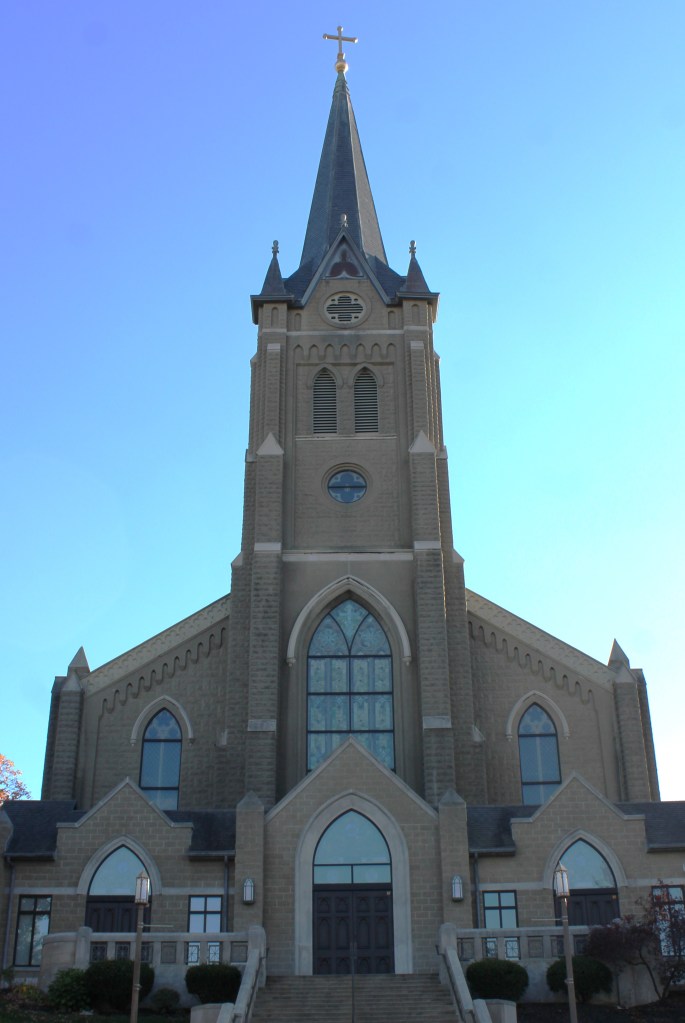
If the goal of a Gothic Cathedral is to pierce heaven, then St Mary is Lafayette’s spear. Standing at an imposing 170 feet, its spire is visible throughout the city. Dedicated in 1866, St Mary became the mother church of the Diocese of Lafayette-in-Indiana in 1944. The cathedral venerates its eponymous saint, Saint Mary. The cathedral features a high-pitched gabled roof flanked by three finials and adorned with a golden cross. Originally constructed of brick, it was later clad in concrete to emulate stone. This was likely done to highlight its prominence among Lafayette’s many brick churches. On each side of the spire are corner buttresses, crowned with parapets displaying stonework with quatrefoil tracery. This is the first of many foils found throughout this building. Remember this motif, as it reinforces the floral themes we will be discussing later. Another notable feature of the front facade are the three pointed arches that punctuate the three entryways. There is also a large stairway with a balustrade leading to the main entrance. Finally, there is a Marian statuary, reinforcing this cathedral’s veneration of Mary. All of these components come together to form the aesthetic profile for the front facade of St Mary.
In my opinion, the front facade succeeds in projecting an air of authority, perfectly befitting the seat of a bishop. The usage of hybridized materials (brick and concrete) to create a stone-like finish is bold but functional. It lacks the rustication found with real stone. Regardless, it still serves to distinguish the cathedral, adding to its unique presence in Lafayette. Stone’s higher cost in Lafayette likely made brick and concrete an economical choice. I think the most impressive feature of this facade is the roof. The slender, high pitched gable, finials and golden cross strike draw your eyes up to the sky. The gold and blue color scheme is beautiful and serves as a prelude for what we are going to see on the inside. The use of foil tracery also sets up well for the aesthetic throughput found inside. Overall, this is very good architectural practice and form in adherence with gothic revival motifs and theory. Yet, as impressive as the facade is, it’s the interior that truly reveals the cathedral’s soul

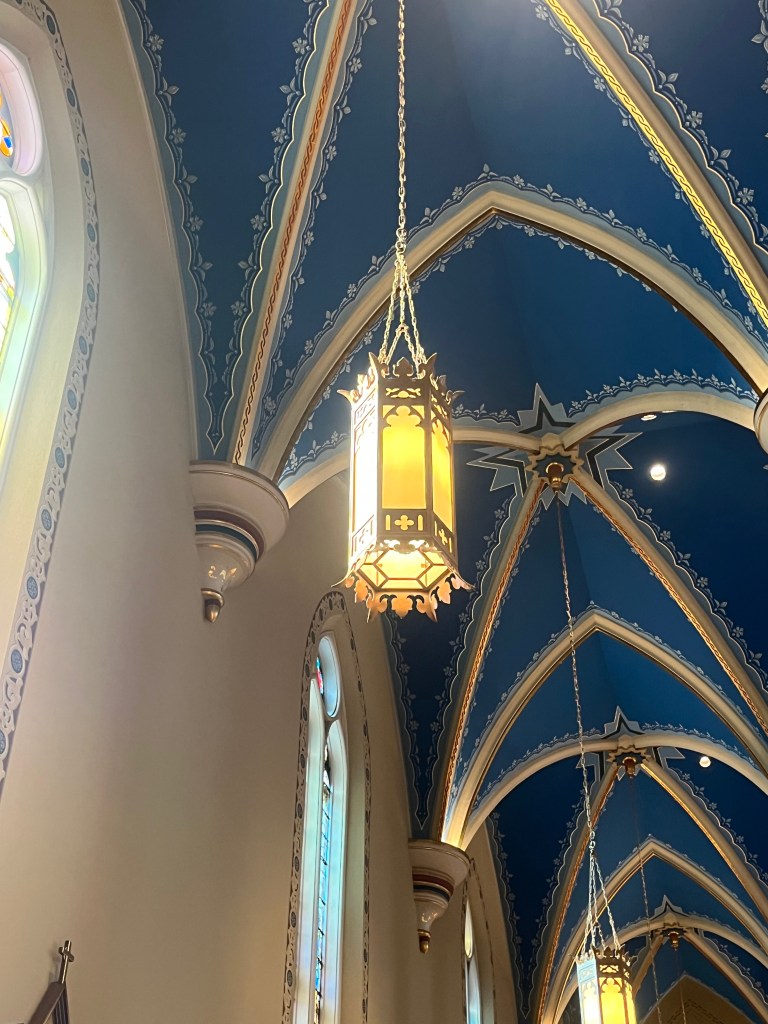
Stepping inside the cathedral, you are immediately inundated with color. Blue and gold paint blankets the ceiling as light pours in from stained glass lancet windows. Golden ribs on the ceiling interlock in a rhythmic, linear pattern. Pendant lighting hangs down, further illuminating the space. The coalescence of details creates a majestic and regal experience befitting Mother Mary. Yet, beneath all the beauty lies technical mastery. The golden ribs are interlaced in a pattern known as the quadripartite rib vault, common in gothic architecture. This kind of rib vault is divided into four sections by the intersecting ribs, reinforcing the structure. The ribs converge onto decorative keystones called bosses. This way, all of the weight is centralized into these points. Furthermore, the cathedral follows the gothic point-load plan. This floor-plan features no transept and a linear, pointed interior. It also further offsets the weight of the building onto load-bearing columns which we will get into later. All of this structural engineering allows for tall, thin walls and windows. It also allows for a building without steel framing to reach such tremendous heights. Yet, understanding a building’s construction is not the same as experiencing the architecture for yourself.
My experience walking into this cathedral was an eye-opening one. I found that pictures did not do the space justice. There are countless details that cannot be captured with a camera. For example, I found the stained glass windows much more beautiful in person, especially with the waxing and waning of the sun. All of the oscillations of time, light, and the depth of proportion that come from using your own eyes are invaluable. The colors pop out much more and the space feels very tranquil. Overall, I think that my experience is a testament to the value of seeing these places for yourself and seeking meaningful architecture. Yet, the devil is in the details. Next, we will be covering the ornaments that complete this cathedral aesthetically.
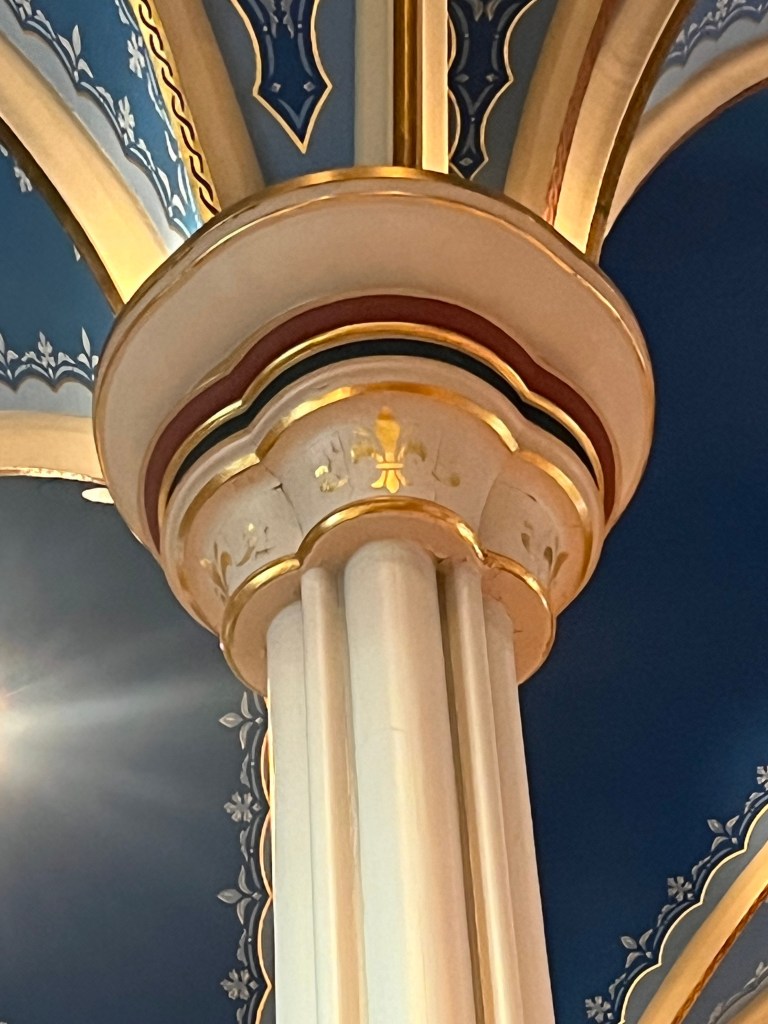


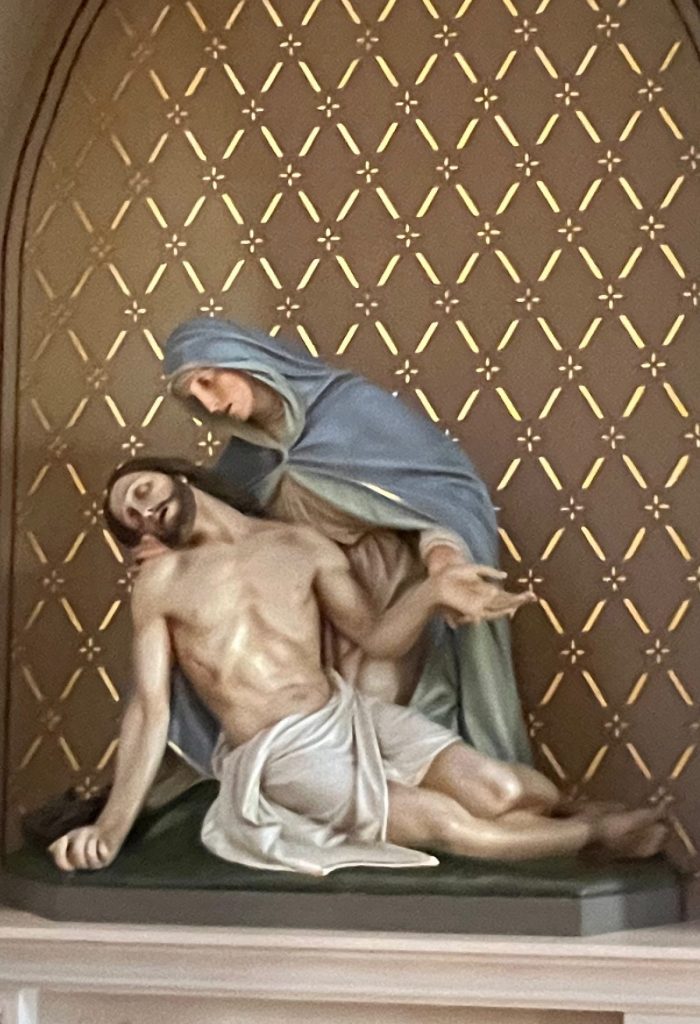
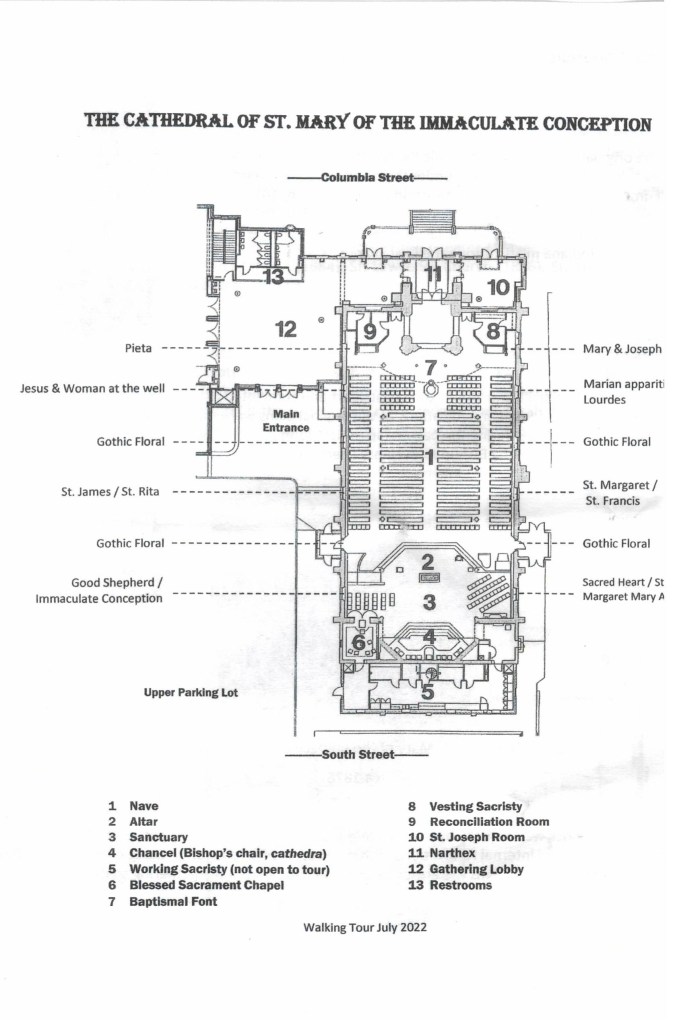
Just as Christ had twelve apostles, so too does this cathedral have twelve columns. Both these columns and the apostles are integral to holding up the church and in this case the cathedral. The columns are compound columns. This means multiple additional shafts have been attached to a central load-bearing mass. The capitals of these columns are accented with a golden fleur-de-lis, a typical Marian symbol. These columns divide the Cathedral into a central nave and two aisles lined with wooden pews. The walls lining both aisles feature fourteen frescoes depicting the fourteen stations of the cross. In back of the sanctuary there is a Pieta statue featuring Mary wearing blue, holding the body of Christ. This blue attire, typical of Mary, is the reason why the cathedral has a coordinating color scheme. There is also a statuary of Mary and Joseph above the votive stand, where worshipers can light votive candles.
Details like this are the lifeblood of true theophanic aesthetics. St Mary is rich in Marian symbology and iconography. This attention to detail shows true veneration, not just surface-level admiration. The blue and gold is emblematic of her attire while the French fleur-de-lis is a symbol of her purity and regal station as Queen of Heaven. The Pieta shows her agony at the death of her only son. The columns carry the weight of the church, just as the apostles did. All of these motifs are manifestly Catholic and heighten both the spiritual depth and aesthetic appeal of the space.
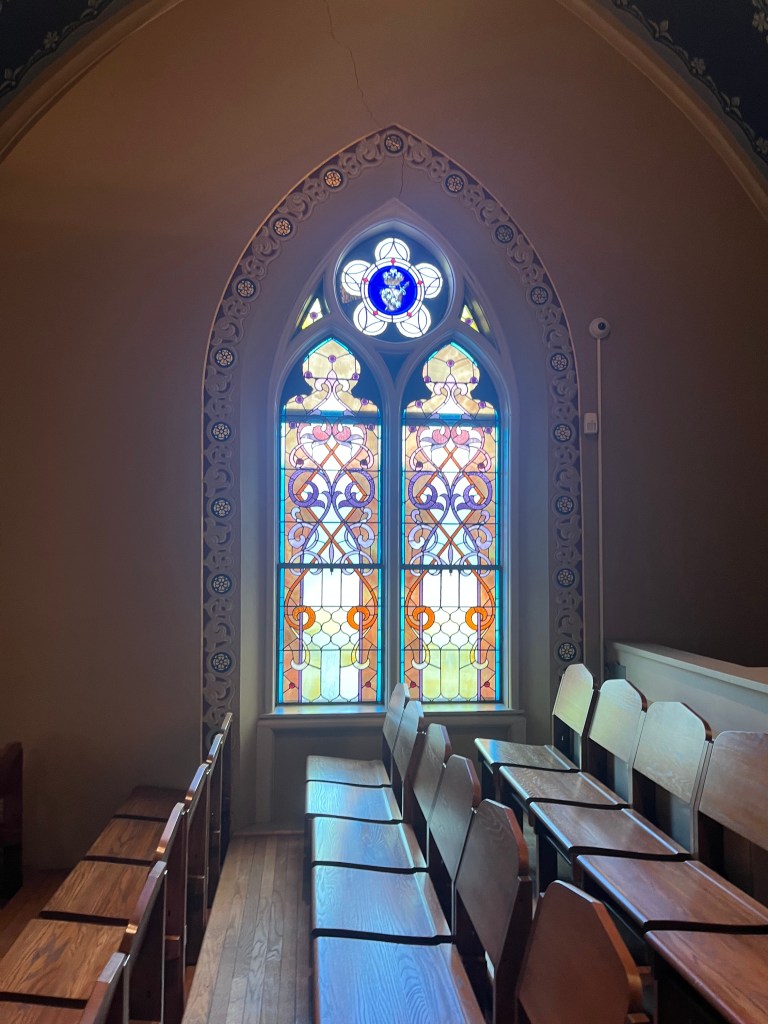


Continuing with the floral motif, the cathedral features many foils. Its twelve stained glass windows for instance are crowned with cinquefoils. These glass ornaments are meant to resemble a flower with the same name that has five leaves. The twelve stained glass windows in the aisles also picture different important figures and stories from the Bible. One such window (pictured above) features depictions of Jesus and Mary, standing side-by-side. As mentioned before, these windows are characteristically tall, allowing for colorful light to pour in. One such window occupies space in the clerestory, behind the organ. The organ itself is situated above a gallery with a balustrade. Ultimately, these foils contribute to the floral symbolism and verticality of the space.
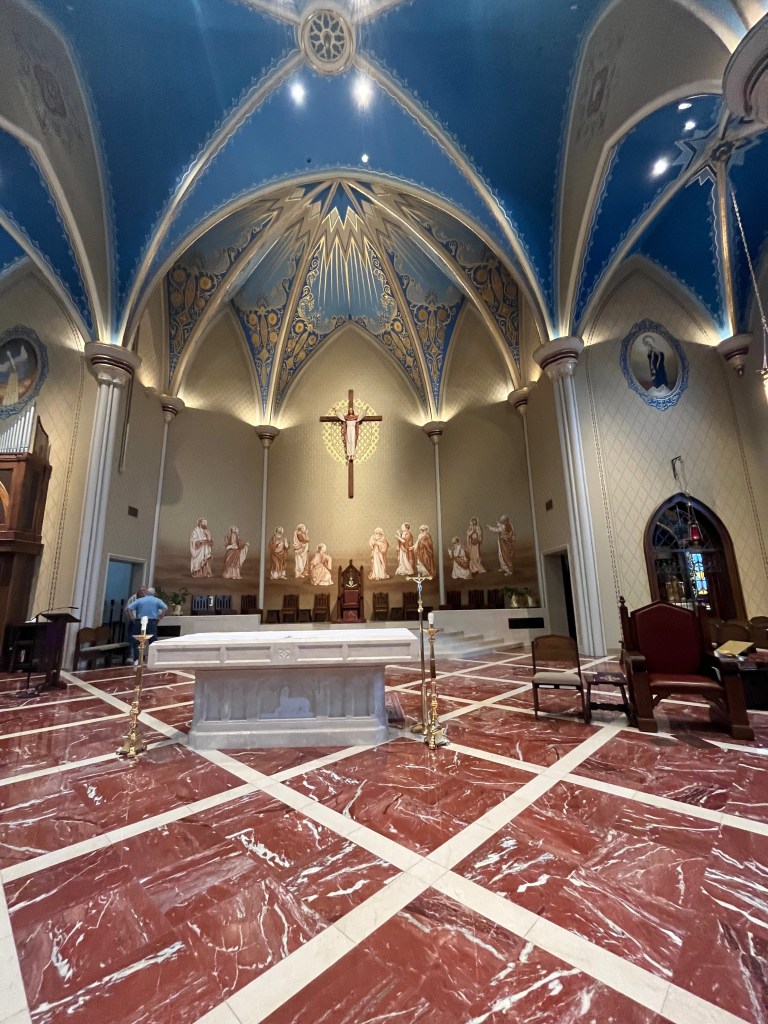
Finally, we come to the front of the cathedral. This is the principal, most important part of any church. Here lies the bishop’s cathedra overlooking a raised marble altar. The chancel also includes a fresco depicting eleven of the apostles worshiping at the foot of the crucifix. The crucifix itself seemingly alludes to the ascension. Christ’s arms are raised and he is wreathed in a golden halo. The roof above the chancel features detailed stenciling in the style of a gold leaf. The cathedra bears the bishop’s coat of arms which references 2 Timothy 2:9, “the word of God is not chained.” The altar also features a bas relief of a lamb. The chancel is also flanked with two oval-shaped frescoes depicting Mary and the Holy Spirit. All of these features were not always present though. They are the product of continual renovations that have been undertaken throughout the years. For example, the apostle fresco was installed in 2001. These changes are the product of successive generations giving to the cathedral. In my opinion these changes have been for the better.
Cathedrals are meant to be the best of the best when it comes to church architecture. I am happy to say that St. Mary is worthy of its distinction and its architectural tradition. Both the Catholic symbology and gothic revival motifs are in-line with expectation, even exceeding it at points. I was very impressed with the both the tracery and the gabled roof. Other features I found appealing were the compound columns, frescoes, and statues. Finally, I found its position in the city, on top of the hill awe inspiring. Its height, mass, and style truly make it one of the most architecturally important buildings in Lafayette, IN.
Though I have high praises, this building is not perfect. I only firmly disliked one aspect of the cathedral, though I understand its pragmatism. That would be the concrete finish on the original red brick. Even though it serves to distinguish the cathedral, it is not reminiscent of real rusticated stone. This is a minor gripe, though I do think it is an important point. Besides that, I am not the largest fan of the crucifix as it appears to depict ascension rather than the crucifixion itself. Finally, I am not a fan of how the entrances protrude out instead of proceeding from the central tower. This makes the entrance space appear blatantly as a later addition.
In summary, I think this is a great cathedral. I had the privilege of visiting it recently and being given a tour by a kind parishioner named Tom Martin who gave me my information. It is due to this that I had so much to speak about and for that I am very thankful. Yet, the cathedral speaks for itself. It is a local gem in Lafayette and a high-quality piece of architecture in its own right. If you are a Catholic and are in the area, I highly recommend you attend a mass here. If not, I would still say it is worth the visit as it is just a beautiful space.
Do you like the building? If so comment your favorite part below

 De Architectura
Leave a comment