

The Death of the Traditional Library
In the midst of the 20th century came the death of the traditional library. Its killers? Modernism, anti-elitism, and the democratization of education. The accomplices? The rise of steel, concrete, and air conditioning. The advent of these developments brought with them a symbolic shift. The elitism of old crumbled under the duress of thousands of middle-class Americans pouring into universities across the country. With them came a building frenzy that abandoned the pomp and ornament of the past. Columns and pilasters were switched for steel frames and cantilevers; stone mouldings and statues were switched for prefabricated concrete. The reverberations of this are felt in the form of the contemporary library. One such library is the beating heart, the roaring engine of Purdue University, the WALC (Wilmeth Active Learning Center)
The WALC serves as both a library and academic hub. Completed on September 22, 2017, the WALC is a contemporary structure, occupying 170,039 square feet across three stories. It cost an awe-inspiring $79 million to construct and is situated in the heart of campus. Designed by BSA Lifestructures and built by F.A. Wilhelm Construction Company, Inc. It is a part of Purdue’s IMPACT program and is utilized for an experimental form of “active learning.” The building is dedicated to Thomas S. Wilmeth and Harvey D. Wilmeth who were brothers and Purdue graduates in the fields of Electrical and Chemical engineering respectively.

Exterior and Location
The WALC is situated in the center of Centennial Mall, between Wetherill Hall and the Mechanical Engineering Building. It features clean rectilinear massing with a horizontal emphasis. The building’s construction uses simple yet effective materials. Constructed primarily of brick and concrete, it integrates well into Purdue’s architectural tradition and visual homogeneity. Seven large, vertical steel-framed windows provide visibility into the reading room. These windows allow light to pour in, increasing visibility on the interior. Beneath the windows are cantilevered overhangs, which provide protection from the elements for students standing or studying outside of the library. The roof is covered with terracotta shingles, a warm, recurring motif of Purdue architecture. These elements coalesce into facades that reflect Purdue’s identity and contemporary architectural practice.
I think that based on location, investment, and purpose, the WALC is a principle building of Purdue. Personally, I find the exterior aesthetically mute, but it is easily identifiable as a Purdue building, mostly from the terracotta roofing. I do think it looks clean, modern, and inviting though. The quality of life additions, such as the overhangs, are a good gesture as well. Overall, I find the exterior to be just alright—certainly paling in comparison to the interior, yet still inoffensive.
Interior and Utility
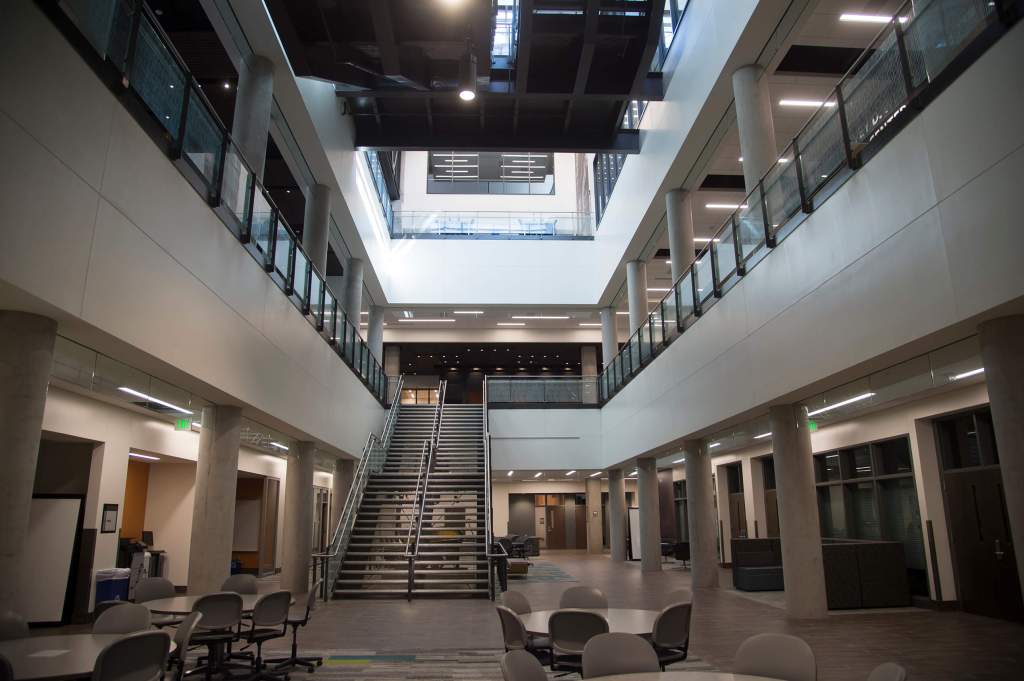
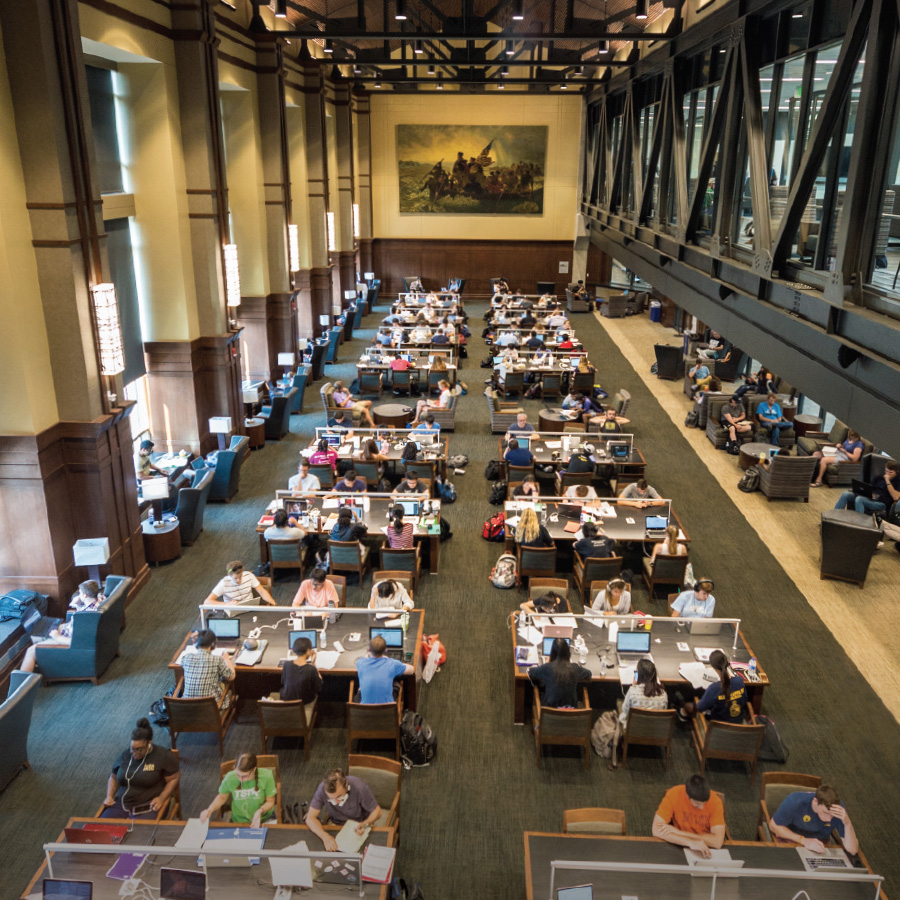
The first thing you notice upon walking into the WALC is the open floor plan. High ceilings trail into broad, central staircases that take up a large part of the building. Modern fluorescent lights beat against open-faced classrooms with facades of glass and steel. Almost every turn has pictures and remnants of the Purdue Smokestack, the regalia of industry. Modular seating, large tables, and rows of computers are common throughout the building. Clerestory windows line the space beneath the roof, inviting even more light in. As previously mentioned, the WALC spans four levels—three above ground and one below. The space is further accommodated with multiple experimental “active learning” facilities. Eye2Eye, 6round, and SCALE-UP are just some of the experimental classrooms, all with different orientations and goals. Eye2Eye, for example, is unsurprisingly about sitting eye-to-eye with students in groups of four, seated at long benching tables. Chief among the facilities is the Mullins Reading Room. It features rows of desks, hanging pendant lighting, a slatted wood ceiling, and a steel mezzanine overlooking the room. On the north wall, there is a massive painting depicting George Washington crossing the Delaware. Finally, there are columns lining the wall, punctuated by a base of warm, stained wood. Overall, the room is a marvel to study in and gives a great view of the Purdue Bell Tower. Last but not least, there is a café on the ground floor, Au Bon Pain, as well as 3D printing materials, the Library of Engineering and Science, and the Knowledge Lab.
I find the interior of the WALC interesting for many reasons. The primary reason is the economy of space. The staircases that occupy the center of the building take up enormous swathes of it. I would argue that it is even more space than the foot traffic of the building demands. Yet, the open design that coincides with this adds innumerable boons. The influx of light, the circulation of air, and cross-building visibility being some of them. There is almost nowhere in the building where you cannot see other students working, reading, or studying. This creates an environment of shared rigor, and 24/7 efficiency. The numerous classroom designs also contribute to this rigor. They foster collaboration and an interdisciplinary diffusion of information and ideas. Add to this the numerous accommodations: a cafe, the knowledge lab, and the reading room, and it is unsurprising this is one of the most popular buildings on campus.

Style and Consequence
The WALC is undeniably contemporary in its construction. It dances with concepts of light and open space. It successfully attempts to communicate the identity of Purdue while keeping with modern comforts. It lacks the ornament of older libraries, yet it compensates with its feats of engineering. The mezzanine in the reading room, the clerestory window, the open floor plan, and its abundant lighting are just a few of these. This is the ultimate Faustian bargain of architecture. The more efficient, comfortable, and modern we make it, the more it departs from the past we love. For instance with this building, ornamentation like acroterion or mouldings would have been very expensive. This could have lead to its construction going over budget or cutting corners on amenities and utilities. It is alright to mourn the lack of beauty caused by this. It is also important to celebrate the successes of this building philosophy. Ultimately, you must ask yourself the question, what is beauty worth? Is it worth your comfort? your money? I will leave the answer to you.
If you enjoyed reading this piece, then like, comment, and subscribe to De Architectura for more.

“A university is just a group of buildings gathered around a library.”
–Shelby Foote
Sources:
BSA Lifestructures. Wilmeth Active Learning Center. BSA Lifestructures, https://www.bsalifestructures.com/project/active-learning-center/.
Purdue University Libraries and School of Information Studies. Purdue Campus Facilities and Buildings Historic Database. Purdue University Libraries, https://collections.lib.purdue.edu/campus/buildings/316.
Purdue University News. “Wilmeth Active Learning Center to Offer Advanced Learning Environment.” Purdue University News, Purdue University, 22 Sept. 2017, https://www.purdue.edu/newsroom/archive/releases/2017/Q3/wilmeth-active-learning-center-to-offer-advanced-learning-environment.html.
Purdue University Senate. WALC Classrooms. Purdue University, https://www.purdue.edu/senate/documents/meetings/WALC_Classrooms.pdf.
Felder, Richard M., et al. “Shifting Culture: Professional Development through Academic Course Transformation.” The Journal of Engineering Education, vol. 108, no. 3, 2019, pp. 303-323, https://doi.org/10.1080/00091383.2019.1547077


 De Architectura
Leave a comment