

Architecture in Pursuit of the Stars
Long has humanity thirsted for the cosmos; long has his journey to them been. In ancient times, man built temples for celestial bodies. The sun and moon particularly were the subject of widespread worship. From these monuments man formed a symbolic architectural relationship with the great unknown that continues to this day. Nowhere is this venerative covenant better displayed than at the Neil Armstrong Hall of Engineering at Purdue University.
Standing at 243,059 gross square feet, The Neil Armstrong Hall of Engineering was dedicated on October 27, 2007. It cost in the neighborhood of $70,000,000 in today’s money and was designed by Ratio Architects. It consists of three stories and serves as the principal engineering building on Purdue’s campus. It is dedicated to Purdue’s most famous alumnus, Neil Armstrong.

Exterior and Location
Neil Armstrong stands at the north end of Stadium Mall, east of the Gateway to the Future Arch. It features diagonal linear massing akin to a parallelogram. On the roof is a striking cantilevered steel truss that juts out from the main mass. The truss is also a dark orange color, mimicking the terracotta shingles found throughout Purdue’s campus. Overall, this projection emphasizes the thrust and dynamism of the building conjuring images of planes or rockets. The entrance space is accented by a glass curtain wall, revealing the open interior. Coursed brick with a limestone trim and clerestory band windows make up a majority of the facade. This lends it a modern and permanent feel. The font for the lettering in front of the building is Acumin Pro, a highly geometrical and futuristic sans-serif font.
Neil Armstrong Hall of Engineering is one of my favorite buildings at Purdue. This is mainly due to its unique massing, use of materials, and bold symbolism. Aluminum-clad windows and roofing make the building not only aesthetically appealing, but robust against the elements. The coursed brick and limestone trim evokes the classical soul of Purdue and it’s architectural tradition. The curtain wall reveals the spacious interior and gives a relentless feeling of contemporaneity. The cantilevered steel truss is a masterwork in both symbolism and engineering. Its linear massing makes it principal and visible throughout every inch of Stadium Avenue. These elements create a striking and memorable presence, making Neil Armstrong Hall a functional building and a defining symbol of Purdue’s commitment to innovation.

Interior and Utility
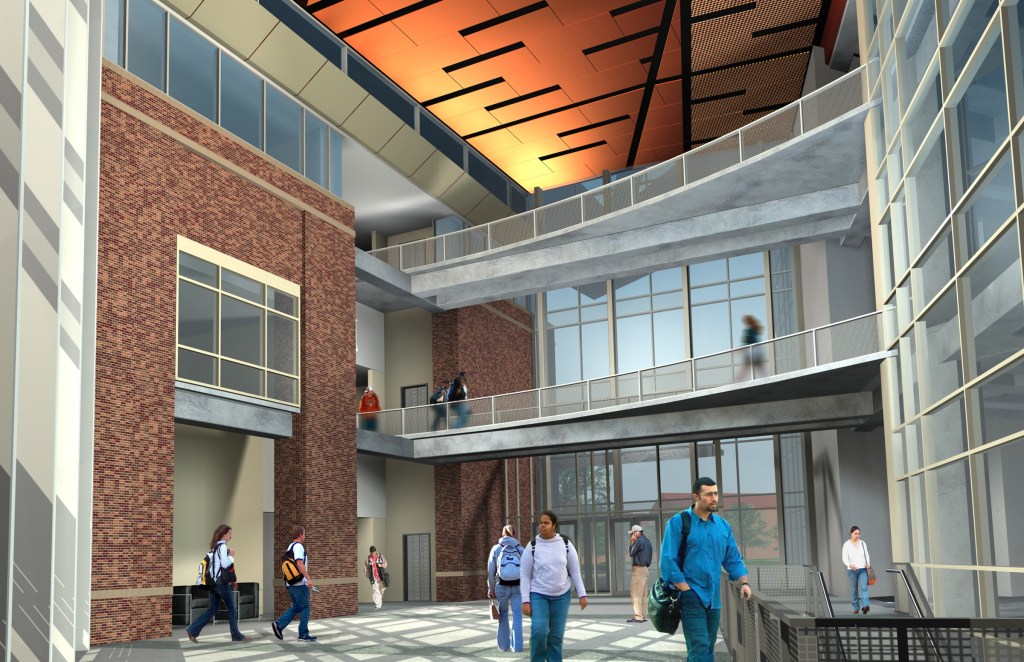
Directly through the doors to Neil Armstrong is the Kurtz Atrium. It is 53 feet tall and features a replica of Apollo One. This is the same unit Purdue alum Roger Chafee trained in. The building features an open floor plan with a breadth of space for students to sit, study, and socialize. Beneath the atrium are crossed walkways that facilitate foot traffic. There are also elevated walkways from the 2nd and 3rd floors that cut through the median of the atrium. Additionally, a second curtain wall lines the southern facade, allowing additional light in. Both the mechanical and electrical components of the building are exposed for the purpose of architectural honesty. It also serves to highlight the importance of engineering in the function of the building. The building features many labs, lecture halls, and classrooms. It also has a coffee shop in the basement.
It is not surprising that Neil Armstrong was consecrated as the principal building of Purdue Engineering. Its immense size, use of space, and innumerable academic facilities make it invaluable to Purdue. My favorite feature of the building is the dual curtain walls. They provide so much natural light it practically eliminates the need for artificial light during the day. I also think that the prefabricated orange steel panels on the ceiling provide warmness while still fronting a futurist aesthetic. The compartmentalization of the building is fascinating as well. You can see parts of each facade intruding upon the interior. The aluminum roofing, steel panels, and coursed brick with limestone trim all make an appearance on the inside. These were all motifs found on the outside as well. This harmony is indicative of the building’s soul and continuity, which further reinforces it as a monument of engineering.
Style and Consequence
Neil Armstrong Hall is many things, primarily a monument to man’s ambition and continued symbolic relationship with the sky and stars. It is the incubator for the minds which bring us ever closer to our age old dreams of exploration. It stands at the crossroads of past and future, fusing elements of architecture from across Purdue’s campus. It also serves to architecturally immortalize Neil Armstrong, forever enshrining him on Purdue’s campus.
If you enjoyed reading make sure to like, comment, and subscribe to De Architectura below!

“The desire to fly is an idea handed down to us by our ancestors who… looked enviously on the birds soaring freely through space.”
– Wilbur Wright
Sources
Purdue University. Campus Facilities and Buildings Historic Database. Purdue University, https://www.purdue.edu/buildings_grounds/historic/database.html. Accessed 29 Apr. 2025.
Smoot Construction. “Neil Armstrong Hall of Engineering.” Smoot Construction, https://www.smootconstruction.com/project/neil-armstrong-hall-of-engineering/. Accessed 29 Apr. 2025.
“Neil Armstrong Hall Of Engineering.” Design and Build With Metal, https://designandbuildwithmetal.com/projects/educational/details/neil-armstrong-hall-of-engineering. Accessed 29 Apr. 2025.

 De Architectura
Leave a comment